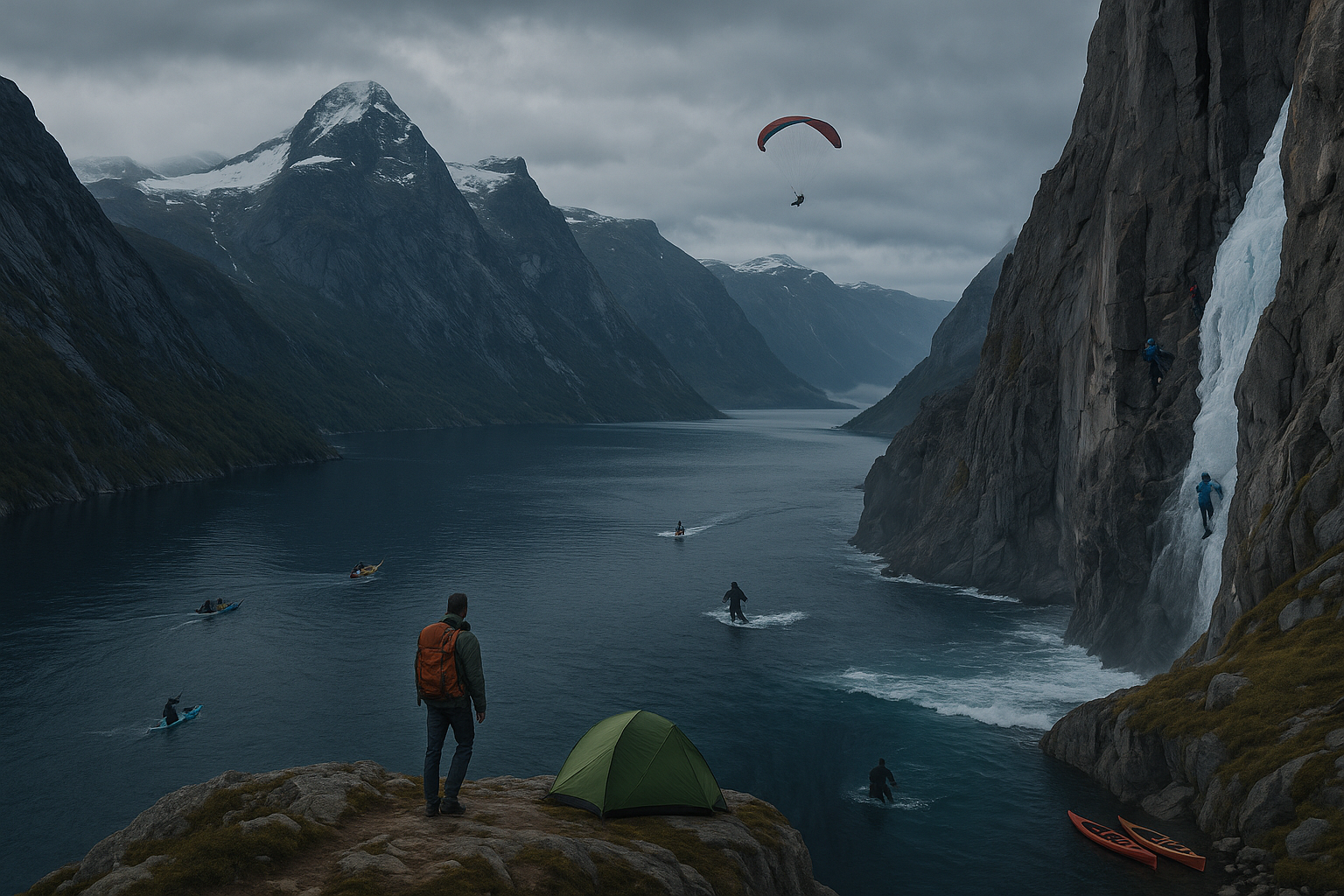
“ONE LAND · ALL ADVENTURES”

Norway is a country where hiking and expedition trekking, alpine climbing and ice climbing, ski touring to sea level, kayaking and canoeing, cold-water diving and surfing, wild camping, caving, dog and reindeer sledding, wildlife safaris, and paragliding above fjords all exist within the same landscape.

In Norway, Allemannsretten is in force – a legal right to walk, cross land, and camp in nature. This applies to approximately 95% of the country’s territory. Around 38–40% of Norway is covered by forests. About 60% of Norway consists of mountainous or highland terrain located above 300 m above sea level.

In Norway, it is permitted to camp almost anywhere. In some places, 15–30 min from a city, you can reach complete wilderness. Large areas have no mobile network coverage. In the north, polar nights and polar days occur, while coastal regions receive heavy precipitation year-round.

From sea level to mountains over 2000 m, it is possible to reach alpine terrain within a few hours of hiking.
Vertical drops of 500–1000 m are common on what are considered “ordinary” trails.
In many places there is no path at all, only a red “T” painted on a rock.

Norway has one of the lowest population densities in Europe. Vast areas exist without roads, without settlements, and without infrastructure.
In Europe, this is one of the easiest places to get lost in nature, even close to civilization.

Norway is one of the most glacier-rich countries in Europe and has the highest concentration of glaciers on the European mainland, with more than 1600 glaciers. Many of them are accessible on foot, without the need for expeditions.

Mixed climbing is common in Norway – rock, ice, and snow combined. Norway is also one of the world’s leading ice-climbing countries.

In Norway, ski touring from 1500–2000 m down to sea level is possible. Avalanches are an everyday reality.
This is not a country of endless winter – it is a country where winter never fully disappears.

Norway’s coastline is approximately 100,000 km long (including fjords and islands), creating an almost endless kayaking route without borders or permits. Expedition-style kayaking is rare in Europe. Water temperatures are often 6–12 °C, even in summer.

Norway offers multi-day canoe routes through interconnected lake and river systems, where portages (carrying the boat over land) are an integral part of the journey. In fjords, it is possible to dive along underwater cliff walls hundreds of meters high, with visibility often exceeding 20–30 m.

Along the Norwegian coast, surfers ride waves generated by North Atlantic storms – making it one of the coldest regularly surfed regions in the world, where surfing takes place in Arctic conditions. In Norway, ice swimming takes place in fjords, where depths of hundreds of meters begin right at the shoreline.

In Northern Norway, there are cave systems where water flows through limestone formed over 400 million years ago.

In working conditions, polar sled dogs can travel 50–100 km per day, for several consecutive days, at temperatures of –30 °C.
Reindeer are able to pull sleds through deep snow because their wide, flexible hooves act as natural snowshoes, a method of transport used for thousands of years along Sámi migration routes.

In Norway, whales, orcas, musk oxen, and sea eagles are observed outside reserves, along natural migration routes, where encounters are never guaranteed – and therefore always authentic.

In mountainous regions, cyclists regularly climb 1000–1500 vertical m in a single day, often in wind and rain.

In Norway, paragliders launch from fjells, where orographic winds and steep slopes allow them to glide directly above fjords, sometimes for several kilometers without losing altitude, creating one of the most visually dramatic flying environments in Europe.

Similar Posts