Places That Shape Norway
This section is not a static encyclopedia. Norway is not a single landscape.
It is made up of thousands of distinct places — each with its own name, form, history, and meaning — together defining the true diversity of the country.
This section — Places — is dedicated to those places: real destinations that exist on the map and in human memory.
Places is about how Norway is built from points — and how those points, together, form a nation.
The section begins with places that have long become symbols of Norway and continues toward those that are still waiting to be discovered.
It starts with the most well-known destinations and gradually moves toward lesser-known, but no less meaningful, points on the map.
Within the NorwayStories project, these places will be gradually researched, visited, and documented in person — one by one — through real journeys, observation, and experience, while recognizing that the places presented here represent only a part of a much larger Places landscape that extends far beyond any single list.
Norway is a country where scale shapes identity. It contains around 450,000 lakes — 21 larger than 50 km² and 1,242 exceeding 1 km². The coastline is formed by 239,057 islands and 81,192 skerries, while inland approximately 4,850 rivers flow, linking mountains to the sea.
Glaciers have carved this land. Norway has around 2,534 glaciers, which have created more than 1,100 fjords — and in broader definitions, the number of fjords may reach 1,700. From these steep landscapes fall more than 10,000 waterfalls, although only 300–500 of them are regularly visited.
The land also holds depth. There are approximately 50 caves longer than 1 km, ranging from 1,000 to 25,000 meters in length. The landscape is structured by around 65 major valleys, while along the coast there are about 12 documented tidal whirlpools, and in the west roughly 26 core areas of coastal rainforest — one of Europe’s rarest forest ecosystems.
Norway’s geography does not end at Europe’s borders. In Antarctica, within Norway’s territory of Dronning Maud Land, there are around 430 mountains and nunataks, rising above the ice as distant yet integral geographic points.
These numbers describe a system — a land composed of hundreds of thousands of natural points.

This image is artificially generated using AI and depicts a conceptual landscape rather than a specific real-world location.
Norway’s relief is shaped by mountains that define both the landscape and movement through space. The country has approximately 1,000 documented significant mountain peaks, with elevations ranging from 1,650 to 2,469 meters, and 22 of these peaks rise above 2,300 meters. This scale and diversity of landscapes explain why Norway has more than 3,400 protected natural areas across various categories. Among them are 49 national parks, covering vast, largely untouched territories, and around 200 landscape protection areas, where nature and human presence coexist in balance.
Particular attention is given to wetlands and habitats. Norway has 63 wetlands protected under the Ramsar Convention, approximately 52 important bird areas, and 23 national wild reindeer areas, which are critical for preserving one of Europe’s last remaining populations of wild reindeer.
Norway also contains around 3,000 natural monuments — individual features of special geological or biological value — as well as approximately 3 strictly protected marine areas, safeguarding fragile ecosystems beneath the water’s surface.
However, nature here is not only protected — it is also monitored. Around 300 unstable mountain masses have been identified across the country, many of which are under continuous observation due to the potential risk of major landslides. This serves as a reminder that Norway’s landscape is alive — it breathes, moves, and continues to change even today.

This image is artificially generated using AI and depicts a conceptual landscape rather than a specific real-world location.
In Norway, history is not confined to museums — it is embedded in the landscape itself. The country has more than 115,000 registered cultural heritage sites, documenting human presence across thousands of years. This heritage is interpreted and preserved by around 500 museums, many of them located directly within historic environments rather than separated from them.
Medieval Norway remains clearly visible in the terrain. The country contains approximately 100 medieval ruin complexes and 28 stave churches — unique wooden structures that merge Christian architecture with older, pre-Christian traditions. Even earlier layers of history are preserved in more than 150 runestones, of which around 50 are especially well known and accessible.
A rarer and more enigmatic layer of heritage is formed by stone labyrinths. In Norway, only about 20 stone labyrinths are known today, most of them located in coastal regions, reflecting ritual practices and symbolic thinking that predate written sources.
Norway’s history is inseparable from the sea. The country protects 209 historic vessels, while beneath the surface far more stories remain hidden — approximately 2,100 shipwrecks have been historically recorded, bearing witness to trade, fishing, warfare, and seafaring across centuries.
On land, these narratives are complemented by sites of power and governance. Norway has around 78 manor houses, 17 royal palaces, and 23 historic castles and fortresses, representing different stages of political authority and defense. Before national unification, the territory was fragmented into approximately 13 small kingdoms, whose borders and influence still echo in regional identities today.
These figures reveal that Norway’s history is not a single timeline, but a layered landscape, where stone, wood, water, and terrain preserve memory. From this heritage emerge the Places — locations where the past remains present.

This image is artificially generated using AI and depicts a conceptual landscape rather than a specific real-world location.
Norway’s inhabited landscape is finely structured. The country is divided into approximately 14,000 grunnkrets — the smallest statistical units — within which there are around 990 urban settlements (tettsteder) and a network of 104 cities.
Norway’s infrastructure is adapted to complex terrain. State and county roads are crossed by approximately 19,700 bridges and road structures, supported by more than 1,000 road tunnels. The coastline is connected by around 80 ferry routes, while maritime transport is sustained by 32 main national ports, approximately 600 state-registered fishing harbors, and around 950 guest harbors.
Air transport is provided by approximately 119 airports — civil, military, and private — while inland waterways are linked by two canal systems: the Telemark Canal and the Halden Canal.

This image is artificially generated using AI and depicts a conceptual landscape rather than a specific real-world location.
Norway is a country where the journey itself often becomes the destination. The landscape is crossed by 18 national tourist routes, linking some of the most dramatic scenery and turning travel into an experience. Alongside them are 10 national cycling routes, offering a slower way to sense Norway’s scale, and more than 30 via ferrata routes that run through steep cliffs and mountain slopes.
These routes are not just lines on a map — they are ways of experiencing the country in motion.
Travel is supported by a wide infrastructure. Norway has around 1,000 hotels across different categories, from city centers to remote regions. In the mountains and natural areas, approximately 550 DNT cabins form a unique network for hiking and overnight stays.
In addition, around 20 permanent “Bondens Marked” operate across the country, with a total of 30–40 seasonal markets, serving as local hubs for food, culture, and social exchange.
Active outdoor life is part of Norwegian culture. The country has around 200 alpine ski resorts, approximately 100 major ski-jumping hills, and hosts about 50 significant ski competitions each year. Beneath the water, around 160 diving clubs operate, while on the water more than 150 sailing clubs take advantage of the coast and fjords.
This dynamic is reinforced by public life: Norway hosts approximately 4,500 major events and exhibitions annually, filling cities, towns, and regions with movement and people.

This image is artificially generated using AI and depicts a conceptual landscape rather than a specific real-world location.
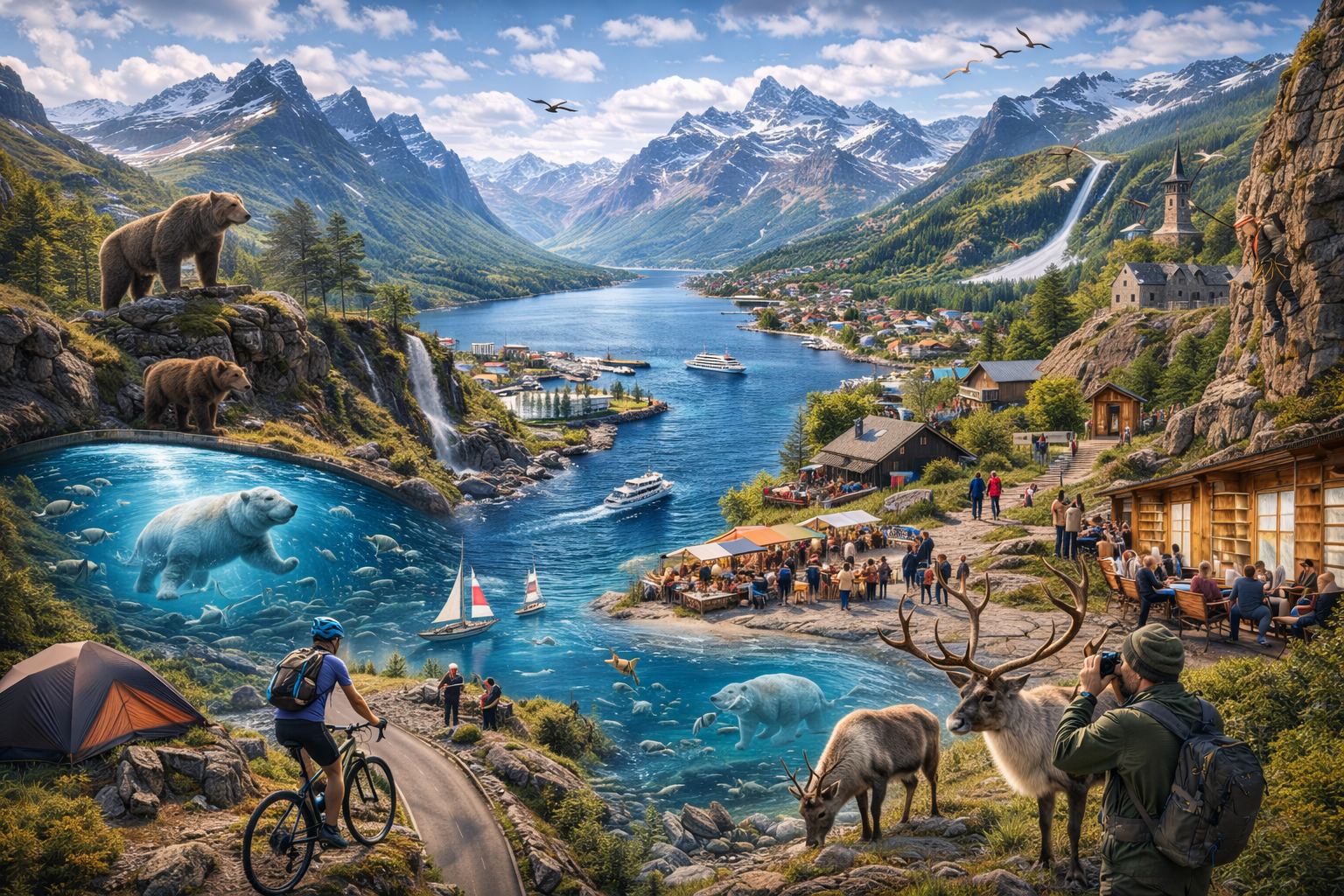
In Norway, wildlife protection and public education are closely connected. The country is home to approximately 8 large zoological parks, which function both as educational institutions and as centers for research and species conservation. In addition, there are around 7 public aquariums, presenting marine life, coastal ecosystems, and Arctic environments.
Spiritual and cultural education is also represented in a historical context. Norway has 6 regional pilgrimage centers, which combine history, travel, and the transmission of knowledge about the cultural landscape.
The foundation of knowledge is supported by a broad library network. The country has approximately 700 public libraries, ensuring access to education across urban and rural regions alike.
Wild reindeer play a special role in wildlife management. Norway has 9 wild reindeer management boards (villreinnemnder) — institutions responsible for overseeing wild reindeer territories and maintaining a balance between nature conservation, research, and human activity.