
About Norway’s mountains — as space, not as a goal.
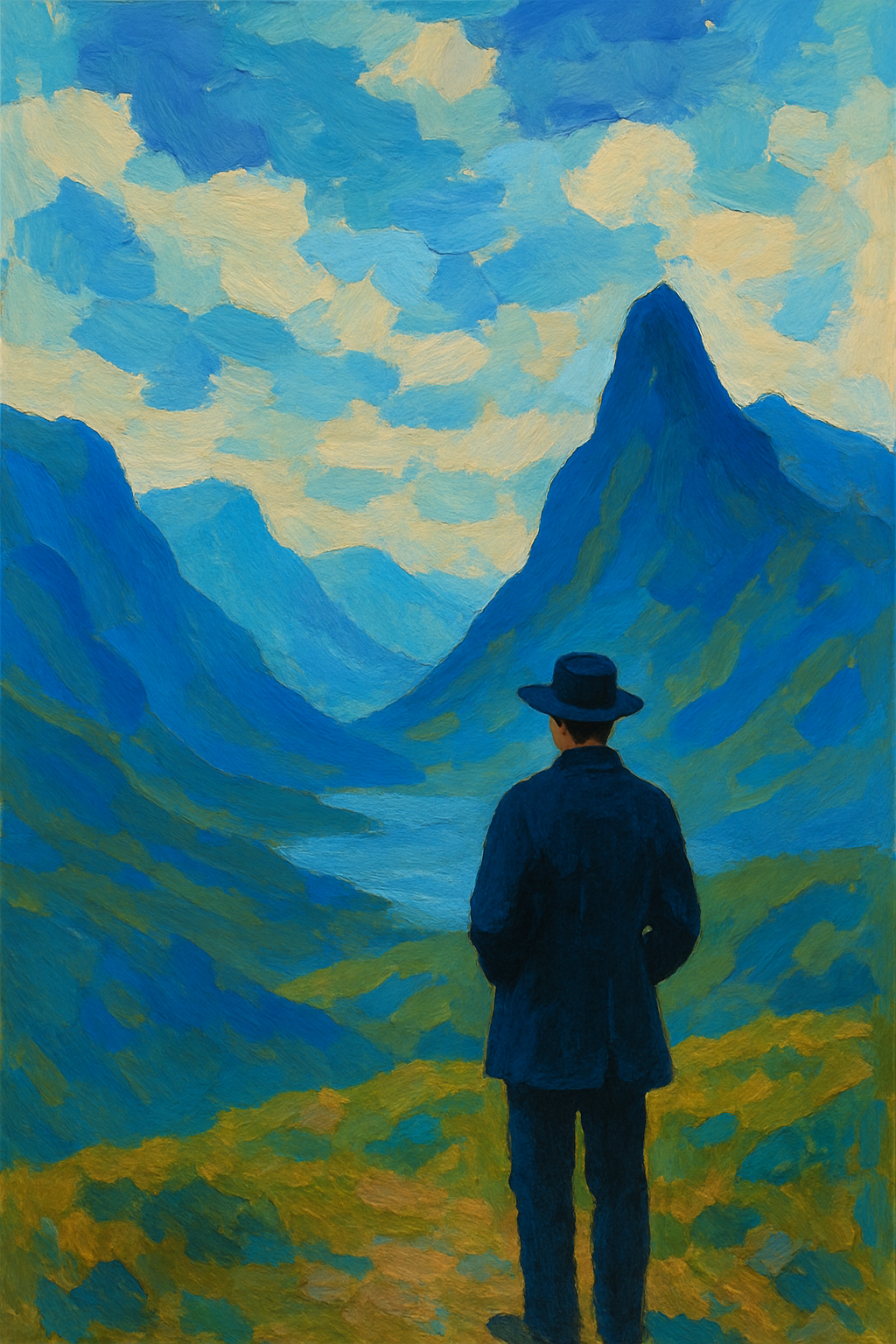
Introduction — what this category is not.
This Mountain category was not created only to list routes, elevations, or records.
It is not meant only as a guide to “where to go faster” or “what you must see.”
Here, mountains are not presented as objects to conquer, but as a space to enter.
If you are looking for practical information only — you will also find it here.
But it will never be the only or the main thing.
Norway’s mountains — not the highest, but the most present.
Norway’s mountains are not the highest in Europe.
They are not the youngest, nor everywhere the sharpest.
But they are old. Geologically very old.
They are mountains that were not formed to dominate the landscape, but to remain.
In some places they are sharp and dramatic — like Sunnmørsalpene, Lyngen, or Lofoten.
In other places they are gentle, wide, and seemingly endless — like Hardangervidda or Finnmarksvidda.
This diversity is not a contradiction. It is the language of the mountains.
Mountains as space, not as a point on a map.
In this project, mountains are not understood as a “summit,” a “checklist item,” or a “destination.”
Here, mountains are space, process, and experience in time.
More important than where you arrive is what happens to you while you walk.
That is why many articles in this category will end without a reached summit, describe turning back, and speak about stopping rather than moving forward.
Why mountains are central to this project.
Mountains are a place where:
human scale becomes visible, time is felt differently, and comfort is no longer guaranteed.
Mountains do not adapt to humans. Humans adapt to mountains.
That is why mountains are essential for understanding Norway’s nature, Norway’s culture, the idea of friluftsliv, and the meaning of silence.
This category is a foundation for many others.
How the Mountain category is structured.
Mountain is not a single topic. It is a system.
Here you will find articles about:
mountain geology,
mountains in time,
mountains in silence,
mountains in human experience,
mountains as boundaries,
mountains as psychological space,
mountains as cultural symbols.
Some articles will be scientific, others personal, and others visual or philosophical.
All of them belong to the same space.
About “where to go” and “how to be.”
In this category you will also find:
specific regions, mountain ranges, and places to go.
But every such article will always be placed within a broader context.
The most important question here is not: “Where should I go?”
The most important question is: “How should I be in the mountains?”
If you understand the second, the first will resolve itself.
What will not change.
This category will not be shaped only by trends, social media algorithms, or “top 10” formats.
Some articles will be slow.
Some will be quiet.
Some will be uncomfortable.
Mountains are like that too.
An invitation to the reader.
If you are here not only to look, but to understand,
not to consume, but to stay,
then this category is meant for you.
Mountains do not teach speed.
They teach presence.
And this is the beginning of everything that follows.
