
The Oseberg Viking Ship Begins a New Life.
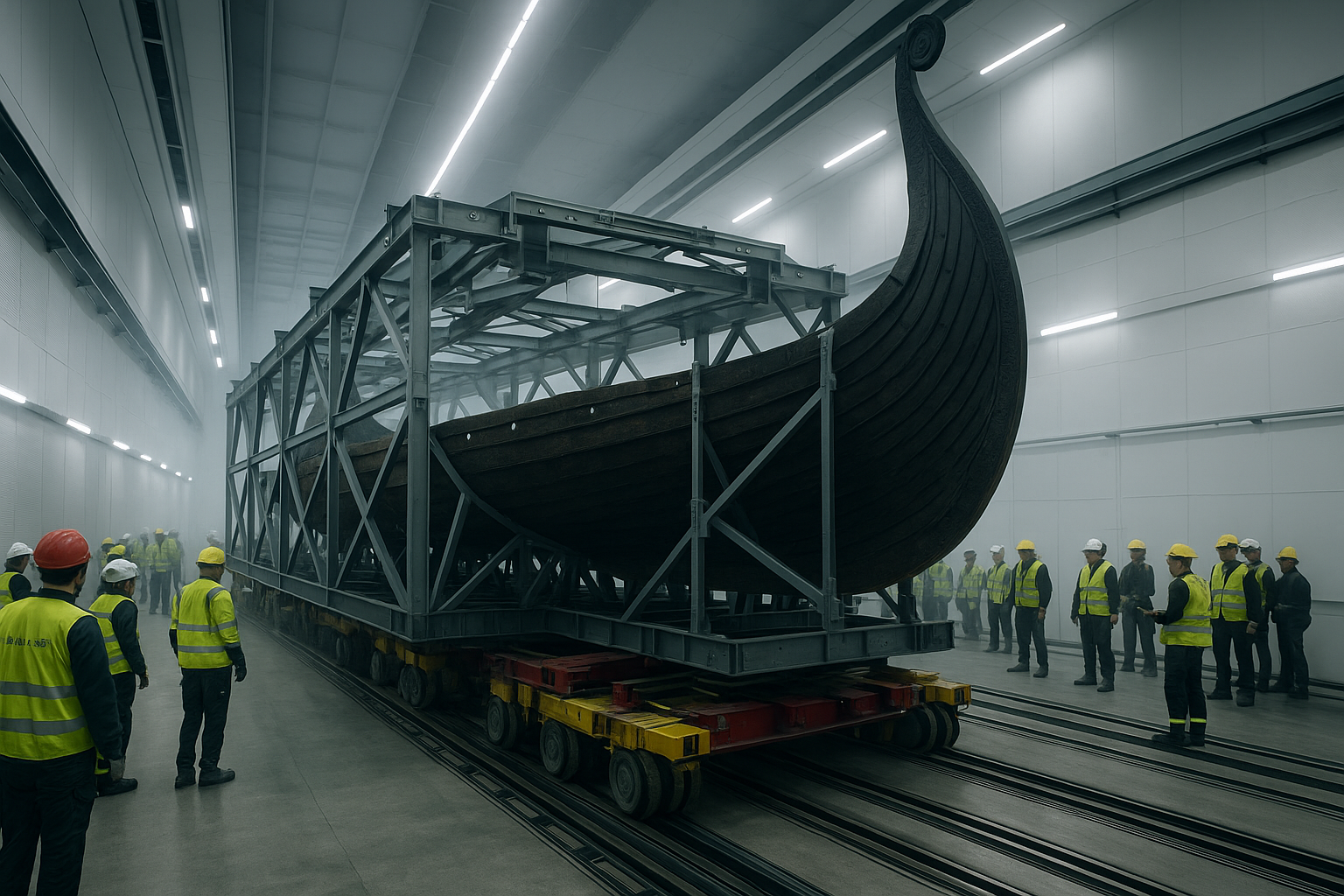
The Oseberg Viking Ship Begins a New Life: A Silent 100-Meter Journey That Astonished the World
Something extraordinary happened in Norway this week — a cultural-heritage operation that felt almost like awakening an ancient treasure.
The 1200-year-old Oseberg Viking ship, one of the best-preserved ancient vessels in the world, was moved to its new home — the upcoming Museum of the Viking Age in Oslo.
Just 100 meters.
But these 100 meters were the most complex, expensive, and emotional meters the ship has ever travelled.

How Do You Move a Miracle That Could Break from a Tiny Vibration?
The Oseberg ship is not just an artifact. It is a massive, delicate organism, built from oak in the 9th century, now so fragile that even a 1–2 degree temperature shift could cause damage.
That is why the relocation required:
- 10 years of planning,
- a team of engineers, conservators, and archaeologists,
- a specially designed steel support frame,
- and a movement speed of 25 centimeters per minute.
This is no exaggeration — the ship was literally walked along rails, millimeter by millimeter.
The professionals involved coordinated their movements and even their breathing to avoid vibrations.
As one museum engineer said:
“We are not moving a ship — we are moving history.”
Why Was This Necessary?
The old Viking Ship Museum could no longer guarantee safe preservation.
The wood had begun to crack, climate control was outdated, and large visitor crowds generated micro-vibrations.
The new building is a different world:
- climate conditions regulated to fractional precision,
- special flooring that absorbs vibrations,
- total protection from temperature fluctuations,
- and an entire structure designed as a massive conservation instrument.
This means one thing:
The Oseberg ship will finally be safe for centuries to come.
A Symbolic Moment: The Viking Ship “Sets Sail” Once More
When the ship reached its new hall on September 10, many felt a quiet, almost surreal emotion.
This vessel, which once cut through ocean waves and carried its two distinguished Viking-Age women to their burial mound, was now entering its third life.
- Its first life — during the Viking Age.
- Its second — after its discovery in 1904 and decades on display.
- Its third — today, in a modern, protected, scientifically controlled environment.
Norwegian media called this moment:
“The final harbour.”
But this “final harbour” is not an ending — it is preservation, a new beginning that will allow the ship to continue telling its story for generations.
What Comes Next?
The new Museum of the Viking Age will open in 2027, and it will be:
- the largest Viking ship museum in the world,
- completely rebuilt and expanded,
- featuring advanced interactive exhibitions,
- and displaying all three great Viking ships together (Oseberg, Gokstad, Tune).
Visitors will not only see an exhibition — they will experience it:
sound, projections, animations, shipbuilding reconstructions, and stories of the people who once sailed these vessels.

Not Only a Technical Operation, but an Emotional One
On the day of the move, hundreds of people stood quietly behind barriers.
Many filmed the moment, but others simply watched with reverence.
Because the Oseberg ship is not only a symbol of Norway.
It is a cornerstone of Europe’s cultural heritage, a masterpiece that shows how skilled Viking-Age craftsmen were — and how many stories remain hidden in the ancient wood.
When the ship rolled into its new hall, museum staff spontaneously applauded.
This was not just work.
It was a moment when history moved together with them.
The Oseberg ship’s relocation covered only 100 meters.
But it symbolizes much more:
Norway’s commitment to protecting its heritage,
the ability of scientists to achieve the impossible,
and our shared desire to understand the world as it was 1200 years ago.
When the museum opens in 2027, this ship — silent, majestic, almost alive — will once again speak to the world.